
Rocks and Stars: Glow-in-the-Dark Rocks and Ghost Stories


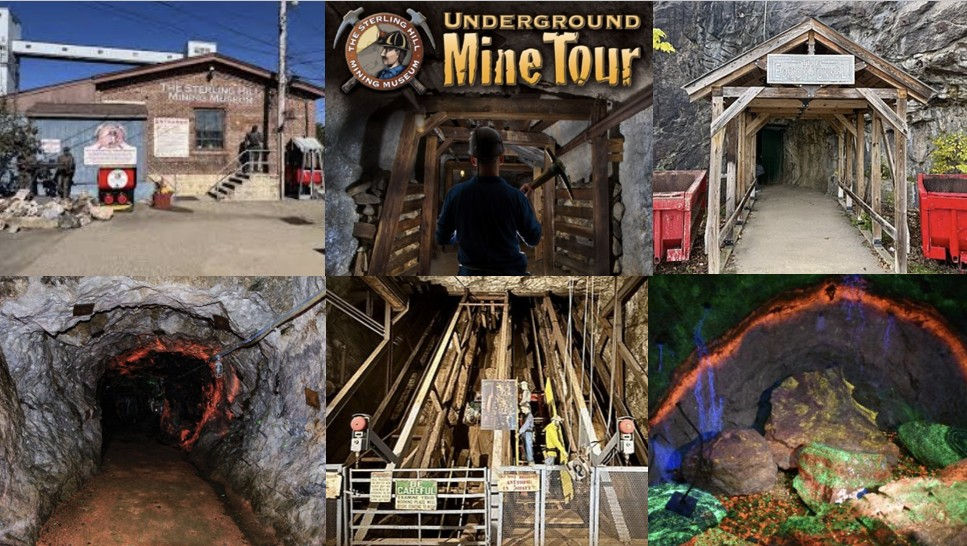
We left the mine by way of one of the original entrances that was buried for 100 years and was dug out. Leaving the mine tunnel felt like departing from a completely different world. The tour certainly gave me a new perspective on what it was like working deep under the earth.
We headed to the Warren Museum of Fluorescence, which is housed in the old mill building. It occupies four rooms filled with over 700 fluorescent minerals and other items. It was named after Thomas S. Warren, an ultraviolet researcher and designer of mineral light, which is a portable black light lamp.
The first thing that we saw was the Color Wall, a 16-foot-wide floor to ceiling display of 100 oversized fluorescent mineral specimens. Our tour guide adjusted the lights. First, she turned on the longwave ultraviolet light. Next, she turned on the shortwave ultraviolet light. And finally, she turned on both. This was followed briefly by a few minutes of total darkness to allow us to see the phosphorescence or after-glow of the mine.
The room turned magical. The formerly pale and flat-looking rocks glowed bright red, orange, pink, green, and blue amidst the darkness. Some rocks even had other-worldly veins of light and brilliant specks in a myriad of shades.
About 15 percent of minerals fluoresce under black light and they generally don’t glow in the daytime. Essentially, ultraviolet light shining on these minerals is absorbed into the rock, where it reacts with chemicals in the material and excites the electrons in the mineral, thus emitting that energy as an outwardly glow. Different types of ultraviolet light—longwave and shortwave—can produce different colors from the same rock, and some rocks that have other materials inside them, called activators, may glow multiple colors.
There are smaller glass cases with fluorescent minerals arranged according to themes – a specific mineral, a specific activator element, a specific locality, or a specific facet of fluorescence. There are also touchable displays. On open ore cars were some fluorescent minerals piled high and suspended above them are longwave ultraviolet lights.
Our guide asked the kids to stand underneath the lights and to have something white on them – a shirt, a backpack, a pair of shoes, or accessories (otherwise, they could just project a big smile to show all their white teeth) and suggested that when she turned off the lights, they could make scary faces while the parents take photos of them. The kids did their best to be the spookiest “glow-in-the-dark” monster in the room.
At the conclusion of the tour, we thanked our gracious tour guide. We learned a lot that morning. Who would have thought that this sleepy little town in New Jersey has so many hidden treasures? And they glow in the dark!
She then gave us directions on how to go back to the Concession Building where the snack bar and gift shop are.
After looking at the mineral items in the gift shop, we headed to the snack bar. My husband ate his take-along sandwich, while I purchased hotdogs for myself and our son. They offered the “Miner’s Lunch” special which included miner’s pasties (a kind of Cornish meat pie), a cookie, and a drink. I didn’t try the meat pie though. After the hotdog sandwich and the bag of chips that came with it, I was full.
They also sold colourful “rock” candies on a stick, which is apparently very popular with kids. But my son did not want one. The snack bar was manned by two friendly elderly guides who are mineral enthusiasts and volunteers at the museum. We thanked them and told them we’d be back after our 1 p.m. activity at the Rock Discovery Centre.
We signed up our son for the rock discovery activity for kids. The outdoor centre was located just outside the mine entrance. The same tour guide from the morning mine tour conducted the “rock party,” which was like a fun Geology 101 class for kids.
Under a shed with a long table filled with specimens, she discussed and showed samples of the three different types of rocks. Then she focused on six particular rocks – basalt, coal, garnet, marble, slate, and sandstone – and explained how they were formed and how we use them in our everyday lives.
After the short lecture, she handed each child a collecting box which looked like a small pizza take-out box with six compartments, then led them to the outdoor area where the six rocks are piled in different areas. The kids were supposed to collect and identify samples of each rock, which they could take home as souvenir.
In no time, the kids were on their feet, examining the piles, choosing their rocks, and checking them against the pictures and descriptions provided for them to make sure they got the right samples. The tour guide was also walking around to supervise the rock hunt, guide the little ones who didn’t know where to go, and confirm if the samples they took were good ones. Once our little boy completed his collection, we chatted briefly with our guide and after the other kids have said their goodbyes, our guide offered to take our family picture.
We wandered around the property for a bit, checking the statues of miners and mining equipment displayed around the grounds – old ore carts, drills, mills, and the like.
From there, we could see the huge conveyor belt and ore tanks of the old mill that loom above the Mine Run Dump and the turn-of-the-century-warehouse-turned-Concession Building.
There was also a huge sluice mine which is another popular attraction for kids. It’s mimics gold panning. Bags of sand pre-loaded with either gems and minerals or fossils can be purchased from the gift shop. Kids can pour them into a sifting container and submerge it into the water and shake continuously until the treasures are revealed. Since my husband and son already did this at Ausable Chasm in New York, we decided to skip it this time.
What my boys really wanted to do was to pick their own rocks at the Mine Run Dump behind the Concession Building. There are two main sections – the International Pile and the Local Pile. The International pile contains diverse minerals from all over the world that people can dig through. The Local Pile contains hundreds of tons of high-grade zinc ore that was derived from the Sterling Hill Mine itself. Much of the ore in the local pile is full of highly fluorescent minerals. There is a shed on the mine run dump which has a shortwave ultraviolet light in which collectors can check their rocks and see if they do fluoresce.
My boys came prepared. They brought rock sledgehammers, rock chisels, magnifying lens, goggles, and a big Home Depot plastic tub which I was afraid they’d be filling up with rocks in no time.
It was around 2:00 p.m. and the sun was at its hottest. I politely declined their invitation to join them in their rock scavenging. Instead, I went back to the snack bar, got a comfortable table beside an electric fan, and read a book.
The two volunteers were still there and since lunch time was over, they had a bit of down time. They were sitting at the next table and soon enough, after answering a couple of questions from them, I found myself dropping my book and engaging in a full conversation with them. We talked about road trips, air travel, gem and mineral collecting, mountains, hiking, Canada, New Jersey, and New York. My boys popped in a couple of times for a break and my husband joined in. But eventually, they went back outside to continue their rock collection.
Our discussions turned personal as they eventually shifted to telling me tales about their student days and their past girlfriends. My two new friends made coffee and gave me some…no charge for me, since I was nice, they said. They even offered me some snacks, on the house, they said, but I assured them that coffee was more than enough.
It was amusing to talk to these gentlemen whom I later learned are members of the museum’s Board of Trustees and Advisory Council, and no less than its President/CEO and Vice-President respectively. Their humble and very down-to-earth demeanor did not hide their brilliance. They were full of wisdom and experience as illustrated by the pieces of advice and the anecdotes they shared with me. One is a retired civil and geotechnical engineer, university professor and lecturer, amateur astronomer, and Co-Director of the nearby Ellis Observatory. The other one is a retired educator who had a long career in developing educational programs and has served in leadership roles in various New Jersey educational commissions. Now, they told me, they are just two old guys giving mining tours and making hotdogs and coffee in the kitchen. I told them that when I get to their age, I wanted to be their female version – cool and funny, still enthusiastic about life, doing things I am passionate about, and sharing my time and knowledge with other people.
As we drank more coffee, the stories became even funnier. And they kept teasing one of the women working at the gift shop. Apparently, she is the younger sister of one of the gentlemen and he just loves picking on her. She was a feisty one as well, hurling friendly insults at the guys from time to time, in response to their jokes.
Then we shifted to ghost stories. Apparently, the mine and the buildings are haunted by ghosts of miners and former female staff. The gentlemen told me about their own experiences, as well as first-hand accounts from colleagues and friends who have spent some time there. We were in the middle of a particularly hair-rising tale when my husband and son walked in, all red and sweaty, hauling the tub full of rocks.
My husband said, “Oh yeah, she likes ghost stories. She claims to have seen quite a number of them.” And the gentlemen laughed and said, “That’s why we like her. And she is really nice, too. You have a very good wife.” I swear I can drink beer with these guys all night long.
However, they became more interested in what my husband and son collected. My husband showed them the rocks and they began discussing geology. We stayed until their closing time and so, we packed up as they did and before leaving the parking lot, we discussed what we were going to do for dinner.
Since we did not have a proper lunch, we decided we’d eat dinner early then head to our next destination back in the New York State – the Kopernik Observatory and Science Centre in Vestal.
We had three options lined up – Krogh’s (the restaurant with the beer barrels inside the mine), a seafood place, and a restaurant-bakery. My husband’s supply of fresh bread was running out, so we picked the third one. But honestly, apart from the bread, I think my husband really wanted to go there because they have risotto on their menu.


Comments