
Rock and Stars: Going Deep into the Mine

The theme for that summer’s getaway seems to be “rock stars” or “rocks and stars,” I told my husband.
What prompted this entire New York-New Jersey trip was Bruce Springsteen’s show on Broadway and we sort of planned everything else around it. But while Springsteen and his E Street Band are indeed rock stars, they are strictly not just that. Springsteen has recorded both classic rock albums and other variations of rock music - folk rock, heartland rock, rock and roll, plus a myriad of other musical genres – jazz, blues, and acoustic ballads.
My husband decided that since were in the area, we might as well visit a mining museum in New Jersey to see some special rocks and planetarium at the southern tip of New York State to view some stars.
After we left New York City, he thought of stopping at Freehold Borough in New Jersey, where Bruce spent his childhood with his family. Two of the three houses he used to live in are still there. The one on 39 Institute Street where he lived between 1955 and 1962 appeared on his “Born in the USA” tour book. Springsteen posed next to a tree beside it. The house was sold in May 2018 and was even on the news.
The one on 68 South Street was his final family home in town. When his parents left for California in 1969, Bruce, who was a teenager that time and was in his first band, turned this house into a “hippie frat house.” It remains standing on a bustling main road beside a chicken and pizza restaurant. The other house on 87 Randolph Street, his grandparents’ home where they first lived when he was a child, had been torn down years ago to make way for a church parking lot.
I asked my husband what he intended to do there and if all he wanted was to catch a glimpse of the houses, he should ask himself if it’s worth all the driving. After all, Bruce or his family aren’t there anymore. And if he wanted to take pictures, I reminded him that the houses are lived in and that the new owners might not appreciate having some paparazzi taking photos of their homes. Besides, there wasn’t enough time. We were planning to be in New Jersey only for two days and we had already lost time because we left New York so late.
It was already 10:30 p.m. when we arrived in Ogdensburg, New Jersey. It is known as the “Fluorescent Capital of the World” on account of its rich deposit of minerals, over 70 of which are fluorescent (glow-in-the-dark). But at that moment, there was nothing much to do except check into our hotel and sleep.
Our hotel room was quite roomy. It felt like a treat after a few days in New York City, where accommodations are relatively smaller for an average price point. My husband told us he wanted to leave by 9:30 at the latest the following morning because it would be a 20-minute drive to Sterling Hill Mine Museum, the main reason why we were there.
The morning mine tour starts at ten o’clock, and he didn’t want to be late.
It was the first time I ever saw my husband so motivated to check out and leave the hotel. Since he couldn’t eat at the breakfast buffet, he already started loading our luggage into the car while my son and I enjoyed a hearty breakfast of pancakes, eggs, bacon, sausages, and hash browns. As soon as we were done eating, we left. We were running a few minutes late, but my husband called the museum and gave them a heads-up. The museum staff it was not a problem. We could just report at the gift shop for our tickets and then join the group at the first tour stop across the building.
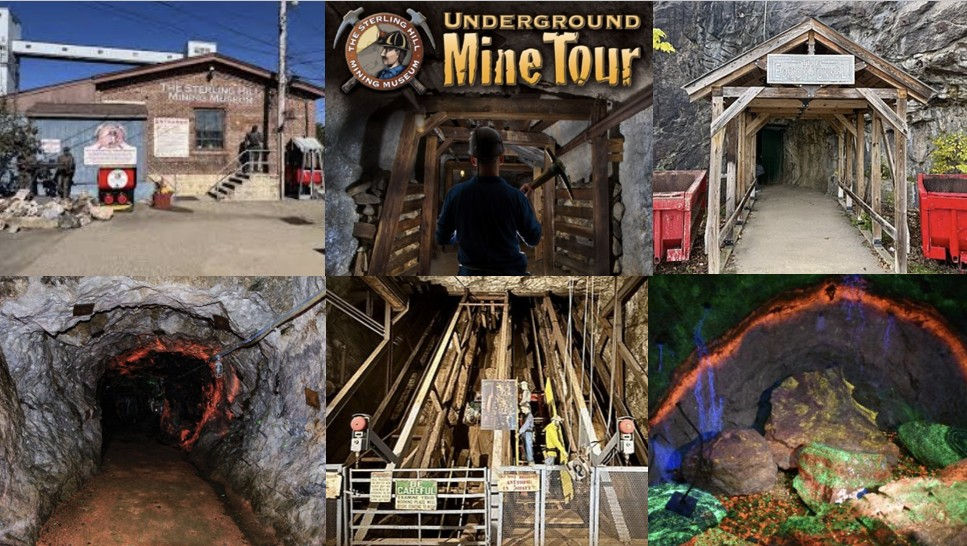
Sterling Hill Mine Museum was once a renowned iron and zinc mine with one of the world’s richest zinc ore deposit. It closed in 1986 and has been turned into a museum in 1989 by brothers Dick and Bob Hauck who bought the facility at a tax auction. Along with the nearby Franklin Mine, it is famous for its collection of fluorescent minerals.
The tour began at the Zobel Hall Museum, which used to be the miners’ change house and still contains their original 300 steel lockers, metal crates, and clothes hangers dangling from the ceiling. It is now home to more than 12,000 mining-related items on display. There are multi-million-dollar mineral specimens on glass cases with fiber-optic lighting. The museum also features a seven-foot-wide display of local fluorescent minerals, which gives visitors a taste of what they will later see at the Warren Museum of Fluorescence. There is also a 10-foot-long interactive Periodic Table representation display with cubbyholes that contain samples of the actual elements, as well as samples of ore from which the elements are obtained, and items made from those elements.
The museum also showcases a plethora of mining machinery and equipment, ore specimens, fossils, meteorites, inventions by Thomas Edison, artwork related to mining, and old mining tools donated by mining families from the area.
I was genuinely surprised by the richness of artifacts in this small museum which was very educational for the kids. The tour guide also made it fun by incorporating a scavenger hunt with her lecture. The kids were asked to look for five items around the museum – dinosaur footprints; real and “fools” gold (there used to be six pounds of real gold on display, but $400,000-worth was stolen in 2011); three local ore minerals (Franklinite, Willemite and Zincite); a magnetic rock; and 5,000 soda cans hiding in plain sight (which turned out to be a humongous aluminum ore). My husband, of course, helped our son find the items. I was just content with taking pictures as my two boys scampered about like boy scouts in the field, looking for clues.
But the real excitement started when we walked to the mine. At the “adit” which was the ground level entrance once used by the miners, the tour guide explained that this would be a walking tour and along the way, we would stop at various stations where she would give us a brief history and description of the room, the tools and equipment displayed, the working conditions of the miners, and the geology of the mine.
She also clarified that we would just be visiting the first level of the mine, about a 1,300-feet walk of tunnel. The lower levels, all 25 of them, are not accessible to the public. Yes, it is that deep beneath ground level. Think of two Empire State Buildings stacked together – that’s how deep it is!
This was my son’s first glimpse of an actual mine (and for me as well; this is my first visit to an underground mine as the one I visited with my husband in Namibia during our pre-baby days was an open pit mine) and for a walking tour, it was not bad at all. The path is flat and level and did not involve any climbing. In fact, it is wheelchair and stroller accessible. It is also well lit, so there was no need for us to bring flashlights or wear headlamps. It was damp and a little cold inside, but 13 degrees Celsius is more than tolerable for Ottawa residents like us, even without a sweater.
At our first stop, our tour guide tapped the ceiling and the wall with an iron bar looking for a section that would echo. Once she found it, she told us that’s where the fault is but quickly assured us that there wouldn’t be a cave-in because rock bolts, which she also showed us, hold the ceilings in place. She also pointed out the huge wooden “air doors” that were once shut to keep the bad air out but are now swung wide open. Carbon monoxide is a typical issue in underground mining operations due to internal combustion engine exhaust and explosive detonation.
There was a boy mannequin standing by the door. Our guide said that in those days, when a miner got sick, he had to send his eldest son, often still a child, as a substitute. His job would be to keep the doors open for proper air circulation. This was long before child labour laws have been implemented.
We went to the lamp room, the shaft station, and the mine galleries dating to the 1830s. Throughout the passageways are dioramas with mannequins dressed as miners and mining equipment right on the spots where they were once used.
The lamp room was where the miners clocked in and picked up their lamps and headlamps. They had upgraded from torches, kerosene lamps, and candles to rechargeable and double-insulated lamps invented by Thomas Edison who had a mine in nearby Sparta. They also equipped themselves with “self-rescuer” devices which are small canisters that when sprayed, converted carbon monoxide to carbon dioxide.
However, this was good for only 15 minutes, so the miners had to make sure they manage to get out within that time frame or else, they’d die of poisoning.
Ever heard of the idiom, “canary in a coal mine?” Nowadays, this means an advance warning of imminent danger. But the terminology originated from the coal mines. In the olden days, canary birds were kept in cages in the lamp room. Canaries are known for their singing, and as long as canary bird songs were heard, the miners were assured that all was well. Once they stopped singing, it meant there was methane or carbon monoxide in the air.
The canaries’ small size, high metabolism, and rapid breathing rate cause them to succumb to toxic gases faster than humans. When they fall dead, it is a signal for the miners to take action before the poisonous gases reach a level that’s hazardous to them. Poor birds!
The birds have since been replaced by detectors with digital readings. While this is certainly a humane resolution, some miners had mixed feelings. The tradition has been so well-ingrained in the mining culture that some workers missed the birds. They were so used to whistling along their birdsong as they worked. Sounds sweet…but can you imagine cute, little Tweety Bird choking to death, instead of contentedly swinging and singing in her cage?
On the other side of the wall was a board with hooks and numbers. Each miner was given a dog tag with his assigned number, and he was supposed to get it at the beginning of his shift and hang it up when he left. This was the supervisor’s way of checking attendance. If a dog tag was missing at the end of the day, it could mean someone had an accident or got trapped somewhere in the tunnel.
But it could also mean someone had just forgotten to return his dog tag. Whatever the case was, it was still the supervisor’s responsibility to check if the employee was alright and that meant going to his house in the evening and knocking at his door. If it was a legitimate crisis, then he would have to initiate a rescue operation. If it’s a simple case of employee forgetfulness, the employee gets reprimanded and penalized by way of extra chores at the mine, usually the most undesirable tasks underground.
There are five compartments in the main shaft that rises 150 feet and drops nearly 2,000 feet down into the earth on a 53 degree angle that runs parallel to the tilt of the ore body. Four are equipped with rollercoaster-like tracks and the last one is for cables, pipes, and ladders. Two of the tracks bring skips filled with ore up out of the mine and two carry cages that hold 40 men and materials. The shaft connects 18 levels that are approximately 100 vertical feet apart. It must have been scary riding a mine cage like that in the dark up and down the different levels underground.
But perhaps, even scarier is the ride through the slanted shafts on these little trains that look like rollercoaster cars with three rows that are elevated like staircases. Three miners sat side-by-side per row, and the cars move on an incline. While this looks more comfortable than the cage, the headroom is only a few inches. If one was tall, one had to stoop down. And if one didn’t want to break his neck or lose his head or other body parts, one had to sit still while the car was sliding down at a very fast rate on the inclined track. Pretty tricky!
Our tour guide showed us their “communication device” which operated on bells. There was a board that served as a guide and listed underground levels with the corresponding number of bell tolls that would signal which level was calling for hoisting.
The kids took turns in operating it while our tour guide shouted the level number.
We saw a coffin-like box on one side. Our tour guide said that this was the “resting station” for miners who were not feeling well, something like a sleeping pod. This “first aid” contraption provided an avenue for all kinds of practical jokes amongst them, and I am guessing, not for the ultra-claustrophobic types (being underground in almost-complete darkness alone is already not for the faint of heart).
Underneath are two dilapidated metal cans which served as the toilets. The term, “use the can” originated from here. The miners back then were instructed to open the lid and kick the can first to get rid of unwanted creepy crawlies, both the tiny and the slithering kinds, before they got down to business. Thank heavens for modern plumbing. I can’t imagine myself being able to do my business in the can…and a very dirty one at that.
And guess who had to clean them? The “forgetful” miners who were being chastised, of course! I bet that after having to do this once, they would have ensured they clocked out after work from hence on.
Our tour guide brought to our attention an interesting corner that was filled with non-mining-related stuff. At the foot of the slanted shaft were four oak barrels filled with Russian Imperial Stout from Krogh’s Restaurant and Brew Pub, a Sparta landmark known for their handcrafted beers. They partnered with the museum to age these for several months for their 20th anniversary celebration the following year.
Apparently, this mine storage process mimics the one used in the pre-mechanical refrigeration days, when beer was lagered in caves, taking advantage of the consistent temperatures and humidity for the perfect brew. Too bad we couldn’t get some samples! But our tour guide said that should we decide to stop there for lunch, we simply had to present our museum tickets, and we’d get 20 percent off our bill.
We passed by the “grizzly” which is a giant strainer with wire mesh that keeps boulders from falling down the next level and damaging the ore crusher. There was a mannequin in the corner, which, according to our guide, represents a “newbie,” whose job was to break the boulders into smaller pieces with a sledge hammer so they would fall through the strainer and into the chasm, 25 levels below. Aside from crushing the big rocks, his job was also to ensure that he himself didn’t fall. If the “newbie” survived this, he moved on to other tasks in the mine. Oh man! I am so glad my job orientation is nothing like this.
The most amazing section was the Rainbow Tunnel, an area of the mine wall where the intensely fluorescent zinc ore is exposed. The room was outfitted with short-wave ultra-violet light and when the regular lights were turned off, the walls glowed bright red and green. The tour guide said that the red one is calcite, while the green one is Willemite. It was magical! She even pointed out a pattern on top of one of the ore arches that’s shaped like a floating ghost. Spooky!
We were led to another tunnel where there was an explosion simulator. Our tour guide asked for a volunteer and since my son was standing close to her, he got first choice. He agreed at the beginning but decided to back out after the tour guide explained the blasting process.
It involved a miner lighting a fuse on sticks of dynamite that he held close (because he needed the light from his helmet) and then quickly running away to safety within three minutes before the blast. An older kid was more than willing to take his place. There wasn’t a cause for worry though, because the “explosion” was just a combination of light and sound effects. No dynamites were used in the demonstration.
Next, we came across what looked like an underground lake that was fenced but turned out to be just water that accumulated over the years because the pumps had been turned off. Opposite is an interesting shaft which our guide described as a movie set.
Apparently, the mining scenes from Ben Stiller’s movie, Zoolander were filmed there. The movie was about going back to his family’s hometown to trace their coal mining roots. The coal mine where Ben’s character was shown toiling underground with his dad, played by Jon Voight, and brother, played by Vince Vaughn, was at this location. They even kept the props of a coal mining car full of fakr coal ore. I took pictures of my boys pretending to lift a heavy rock, though it was just a professionally constructed painted Styrofoam rock.
The tour lasted an hour, but we hardly noticed the time. Our tour guide was very knowledgeable and engaging, and her informative discourse about this mine facility was peppered by interesting narratives, pieces of trivia, and jokes. We came out educated and with a deeper respect for those who have worked here. Those were tough times indeed. When we were in the car that afternoon, my son was still repeating her stories and asking us questions.
My husband also told us that since Bruce Springsteen grew up in New Jersey, he wrote the gritty song, “Youngstown” released on his 1995 album, The Ghost of Tom Joad. The song features coal mines and industrial labor, and details the rise and fall of the steel industry, specifically mentioning the coal mines of Appalachia and the Mesabi iron range.
During this trip, we listened to several Bruce Springsteen albums on our long drive, and I must say my appreciation for him grew. Outside his rock and roll persona, the more commercial image that I knew of him, lies a true musician whose lyrics run deep. He wrote a few songs that touched on the challenges of life - faded dreams, lost love, working-class struggles, and somber reflections on pain, loneliness, and illnesses. He is a true musician, and quite the poet.


Comments