
Quintessential Québec City: Favourite Streets

Updated: Apr 10
Québec City will always stand-out from amongst the other big cities in Canada. Its charming quaintness emanates from a blend of North American and European cultures that is not intrinsically and purely North American, but not comprehensively European either. Rather, it has a unique characteristic that embraces the combined heritage of all the peoples that have lived in that land while never losing touch with its French connections. The result is a seamless amalgamation of various elements of culture that gives it its very own distinct identity.
It is not unusual to hear first time visitors say that being in the city is like being in Europe, but after at least half a day, they’d realize that they are very much still in North America. It happened to me.
The first time I set foot in Québec City on a cruise many years back, I felt transported to another continent as our ship docked at the Saint-Lawrence River and I got a glimpse of the old stone houses in the distance. It was nothing like Vancouver or Toronto…and even its sister city, Montréal.
The architecture, the language, the vibe, the air of antiquity, particularly in the Old Town, all scream, “I am ancient and I have a long, colourful story to tell…” Yet, after my encounter with the locals, I knew I was still home. This is still Canada…but the wonderfully whimsical part of Canada. And I never get tired of exploring it every time I go back.
Our 2017 visit to Québec City was the longest one, out of our other trips. That time, we stayed for five days to watch the parade and enjoy the festivities of Les Fêtes de la Nouvelle-France (The New France Festival). We spent a lot of time wandering around and getting to know its neighbourhoods a little better.
In 2018, we went back to accompany our son when he participated in a national chess tournament. We stayed for four days. In between matches and after the last match of each day, we’d go for walks and sightseeing.
This series will be about the neighbourhoods that we explored.
We have our favourite streets in Québec City.
Rue Saint-Paul
Rue Saint-Paul, once home to several warehouses and wholesalers, has been transformed in the 1960s into a bustling commercial centre filled with antique dealers, art galleries, and restaurants. What is interesting is that in the early 19th-century, these grounds were nothing but shoreline, where residents hauled their boats up on the shore to deliver firewood, vegetables, poultry, and cattle to the city markets. With the growth of port activities, the establishment of side-by-side wharves soon formed this street and shortly after, a large market was built at the north end for heavy and bulky goods such as lime, hay, and stray.
It was on this street where we took my late aunt for her first taste of Québeçois cuisine. We dined at Buffet de L’Antiquaire, a 40-year-old family diner that prides itself with home-style Québec fare that would make any customer feel he is just eating at his grandma’s house. I am guessing it is named after its antique collectors’ neighbourhood because flanking it on both sides were antique shops. If not for the sign outside, I would have mistaken it for an antique store.
Inside, the décor was simple with black and white photographs adorning the red brick walls, an open kitchen on the main floor surrounded by dine-style seating, and a mezzanine area with more dining tables.
We ordered regional food, starting with the thick French pea soup. Then, got three of their house specials – L’assiette Québeçois (meat pie with beans), Le Cipaille (a deep-dish layered beef, veal, pork, and potato pie) and Le Boudin aux pommes et oignons (blood sausage pudding). My husband ordered a plain steak, as his tummy cannot be as adventurous. The servings were more than generous and the dishes were quite rich and heavy, so we ended up taking half of each dish home.
Rue Saint-Pierre
Rue Saint-Pierre, in contrast, used to be the Wall Street of Québec in those days with its opulent buildings housing accounting firms, banks, insurance companies, and even a stock market. Its proximity to the port made it the perfect location for a financial centre.
Nowadays, those stately buildings with their bank vaults have given way to restaurants and hotels. In fact, those 19th-century buildings designed opulently with curving entrances and granite columns to impress clients have been restored to serve as boutique-style hotels. Its rebirth from a financial to a hospitality district was indeed a wise step for a city that has become one of the most visited on the East Coast.
Rue Dalhousie
A block away, on Rue Dalhousie, is the Musée de la Civilisation. Opened in 1988, this museum is the lead of three museums whose objectives include ethnographic collection, preservation, and the stimulation of an evolving conversation about the history of Québec and its peoples (the other two are the Musée de L’Amerique Francophone and the Musée de la Place Royale).
Its permanent exhibition titled, “People of Québec…Then and Now,” displays objects and archival documents, and presents film montages and audio recordings that chronicle the life of the first peoples who inhabited Québec, the contacts between Aboriginals and Europeans, life in the days of New France after British rule, and the arrival of successive waves of immigration. It also features the legacy of the Quiet Revolution and invites reflection about Québec in the present time.
Another permanent exhibition called, “This is Our Story…First Nations and Inuit in the 21st Century,” introduces Québec’s 11 original Aboriginal nations, who worked in collaboration with the museum to tell their stories through five themes that evolve chronologically from paleo-history to the present day. The museum also hosts several temporary exhibitions that focus on Francophone culture, movement, religious heritage, and art.
Rue Saint-Jean
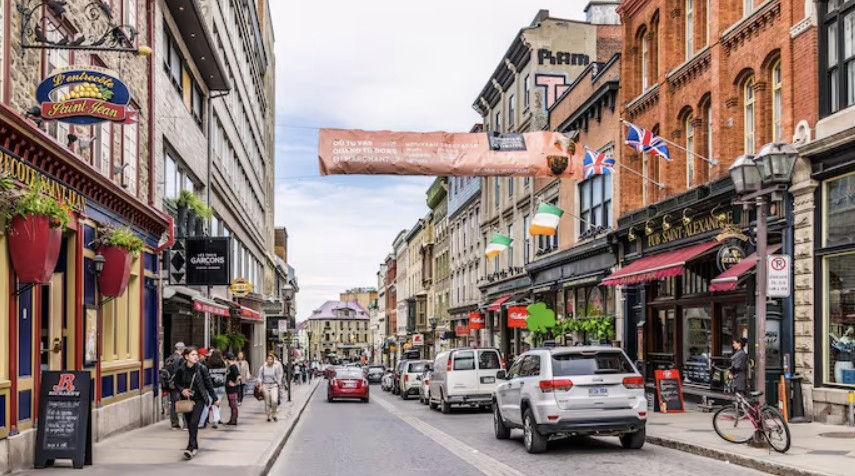
Whenever we’re in the city, we spend a great deal of time on Rue Saint-Jean and I believe this street deserves a category of its own. Starting from the centrally-located Place Youville, a favourite outdoor venue for many city festivals, to Porte Sainte-Jean, the northernmost of the Old City’s main town gates, all the way to the intersection where it meets Côté de la Fabrique, one will find an endless string of boutiques, restaurants, churches, historic buildings, and shops selling eclectic goods. In the summer, it is closed off to traffic on certain hours and becomes a festive pedestrian street.
Rue Saint-Jean is one of the city’s oldest commercial stretches. Merchants settled there in droves in the 19th century and established their businesses. If one observes enough, one will notice that most buildings on the street were designed with a dual purpose – storefront on the ground floor and two-storeys of living space for the family above it.
After the British conquest, it became the main road linking the walled city to outlying districts and business boomed as the population grew. As well, customers at the market across the Notre-Dame-de-Québec church spilled over here and in 1878, when Montcalm Market opened in what is now Place Youville. This sealed the commercial vocation of Rue Saint-Jean, and from that point on, it was connected to the rest of the city by a horse-drawn tram. In the years that followed, the street was widened and a few shops were demolished and rebuilt a few metres back from the curb to accommodate the growing clientele that ply it.
Along this street, my husband loves going to Magasin Général P.L. Blouin, a shop that stands between Rue de L’Hôtel Dieu and Rue Couillard. It is modeled after a turn-of-the-century general store and sells an eclectic mix of Québec-made knick-knacks, antique reproductions, vinyl records, vintage signs and posters, antique magazines, Coca-Cola collectibles, models of old cars, old Canadian licence plates, and the customary souvenir items. It is the kind of store that you go to for checking out funky things that you don’t really need but sometimes end up buying. There is always a novelty item that will catch your fancy. I heard that the store owner is a connoisseur of historical kitsch and it seems like this is the first place where people who want to get rid of their junk from the attic go to. I don’t recall my husband getting anything from here. We have more than enough junk in our basement that still needs to be sorted. He just likes to look. (Phew! Did you hear that sigh of relief from me?)
My counter to that is Boutique Arteq near the corner of Rue Saint-Stanislas. This is where I peruse because it is such a fun shop to be at. It is filled with unique gift items, home décor, kitchen accessories, and even furniture pieces that one doesn’t usually find in regular home stores, such as cat butt fridge magnets, chalkboard party hats, toilet paper printed with Donald Trump’s face, quirky chopsticks, origami wine bottle stoppers, tea towels with witty sayings, unicorn shower curtains with matching bath mats, metallic bean bags, neon bar stools, and so much more. They also carry nostalgia items perfect for your shabby-chic home, like distressed wooden accessories and vintage tin containers. But like my husband, I just look but not buy.
And while my husband spends time looking at French books at Librairie Pantoute, I go to the Galerie Zen across the street to admire paintings and unique artwork by local artists. The gallery displays various art styles – abstract, figurative, art brut, mosaics, sculptures, and even pop art which is always fun.
I must admit that I do succumb to the call of the retail fairy once in a while. Here on Rue Saint-Jean, I like going to Boutique San Francisco that sells trendy women’s apparel designed and made in Montréal. They have a sales rack at the back of the store and I usually find nice clothes for less than half of the original price. I once got an additional discount just because the store clerk noticed that the blouse I was wearing was from their store. I told her that I got a few items there from my last visit and she casually deducted 15% from the already marked down items that I was paying for. Getting a silk summer blouse originally priced at $45 for $15 and a nice party dress for my niece originally priced at $120 for $25 was almost a steal. These are the small victories in life that excite me, believe it or not.
And if memory serves me right, on that same lucky day, I got a good deal at the Crocs Store across the street as well. My gladiator sandals gave up on me that day. I guess, as comfortable as they were, they were no match to my all-day walk along Québec City’s cobblestone streets and winding, hilly roads. As if on cue, the moment the outsole of my right sandal ripped open and I uttered, “uh-oh,” I immediately saw the Crocs signage even before I could assess the damage and figure out where to find a replacement. And what made it even better were the big orange signs on the display windows screaming, “sale.” I did not think twice, so into the store I went. I came out satisfied. They had a “2 for $25” deal and I got myself two pairs of wedge flip-flops in two colours (black and mocha) that were originally for $40 each. They were certainly more functional than stylish, but boy, were they ever comfortable. My feet were happy, and so was I.
(Update: I have taken these Crocs flip-flops on my European trips, and they have served me well in my endless gallivanting, be it on paved roads or cobbled streets, the beach, or mountain paths. And I will take them again to Greece this summer.)
But when I met up with my husband and son afterwards, my husband was aghast. “What are you wearing? What hideous sandals!” he said in horror. My husband has never liked flip-flops or sandals. I just laughed and carried on.
You see, he has never worn anything open-toed outside the house. I am not sure why, but it seems his mom had always made him wear leather dress shoes when he was growing up and that’s what he got used to. In all our dating and married years, I have never seen him wear any other type of shoes except for his tried-and-tested and ever-reliable dress oxfords. He wears them to work, to church, to the mall, and even when we were on tour…with his shorts! I have never seen him interested in buying runners, sneakers, or sandals, or anything casual, but he has at least three pairs of oxfords at any given time and apart from one pair of brown ones, they are all exactly the same brand and the same style. The only other pairs he has are his trusted hiking boots, his heavy German sandals which he calls “house shoes” and wears at home (and that I find strange because in Asia, we wear light slippers inside the house; but apparently, this is what his family does…and apparently, it’s a German thing), and the soccer cleats that he was forced to get two summers ago when our son went to soccer camp (because parents were allowed to join at playtime, but only if you have the proper foot gear). When we went to Eastern and Central Europe, he finally decided to get some reliable runners, because his hiking boots were too bulky.
So, imagine his shock when he saw my friends wearing Birks sandals during our hike to Mount Pinatubo in the Philippines. I told him that locals usually wear rubber slippers everywhere, and some even go barefoot as they trudge up the volcanic terrain.
In any case, I told him that my Crocs flips were good enough for our walking jaunts within the city, and they were super comfy. In fact, after throwing away my broken gladiator sandals, I have worn nothing during that trip but my Crocs. The three other pairs shoes (ballerina flats, loafers, runners) that I brought along were packed away.
And just to clarify, this article is not sponsored by Crocs. I just a fan, based on walking experience. My husband, on the other hand, still maintains, up to this very day, that Crocs footwear was the epitome of “ugly.”
Shoes and apparel aside, my most favourite haunts on Rue Saint-Jean are the food places. There is a lot to choose from, but we have our usual “go-tos.”
We get our fresh bread from Paillard. This café and boulangerie has a wide array of breads and European-style pastries to choose from, all freshly baked onsite. They also have a dining area, where one can order homemade soup, pizza, sandwiches, and salads, and they sell gelato in a variety of refreshing flavours. We often sit there for a quick lunch. Their lunch combos consist of half-a-sandwich with either a bowl of soup or salad.
I recall paying only $11 for a roasted turkey and bacon sandwich on toasted ciabatta with duck confit salad, a chocolate mousse dessert, and brewed coffee. That’s a reasonable price for freshly baked bread with fresh ingredients, better than eating at a fastfood chain. I still remember their seasonal lobster sandwich – generous portions of succulent lobster from Îles de la Madeleine on toasted ciabatta. It was pure heaven!
We’d always get bread to go for my boys’ snacks and for our breakfast the following day. French baguettes, ciabatta rolls, chocolate croissants, and peach or berry Danish rolls are staples for us. For dessert, we like their macarons, crème brulée, and mille feuille. And it’s almost always a guarantee that my son and I will get a scoop of their gelato – half a scoop of raspberry and half a scoop of their seasonal flavour for me, and a scoop of anything chocolate for my boy.
There is another ice cream place we tried on Rue Saint-Jean called Chocolato. They say they are a cross between a chocolate shop and a dairy bar. If you look at their menu, you’d understand why. They have homemade gelato, chocolate and vanilla soft-serve ice cream, and assorted frozen creations such as ice-cream sandwiches and ice-cream on a waffle cone, but the main attraction is the 20 dipping choices made from 100% pure chocolate to coat your choice of ice-cream to create the ultimate frozen delight of your wildest dreams. The dips cover the entire spectrum of dark to milk to white chocolate and range from the plain to the fruit and nut-infused ones. Then comes the rich toppings – peanuts, sprinkles, Froot Loops, coffee beans, pretzel pieces, Oreo pieces, shredded coconut, KitKat bars, maple flakes, caramel chips, maple popcorn, chocolate pirouline, to name a few. And this is not all. They have sundaes and pizza desserts with all sorts of sinful sugar combinations conceivable all in once plastic cup or pastry dough – chocolate syrup, maple syrup, caramel, Oreos, maple biscuits, fresh fruits, sweet cereal, nuts, Nutella, peanut butter, and others. They also offer chocolate fondues and hot chocolate in 20 different flavours.
Seriously, just enumerating the ingredients and recalling the food pictures on their menu is enough to choke me. It is pure calorie attack! My son and I opted for the smallest-sized simple vanilla soft-serve ice-cream on a plain sugar cone, dipped in milk chocolate with no toppings. In its beguiling simplicity, I did not even want to guess the number of calories it had. It was good that we ordered only one because after my son struggled with biting off the hardened chocolate coating, he just gave up and handed the rest for me to finish. Can you imagine if I had to finish two? I guess some treats are pretty to look at but hard to consume. There is a reason why we stick with the light and refreshing gelato.
One thing that I tried there that I would like to revisit next time is the crêpe at Au Petit Coin Breton. Established in 1963, this place has since brought the best of the Breton culinary world to Québec. I tried one of their dessert crêpes with fresh strawberries, pure maple butter, and ice cream on one of my solo walks along the street. It was delightful. Next time, I’d be interested to try their savoury crêpes, and perhaps their gratin dishes (small stuffed crêpe served in a casserole and topped with either a béchamel or aurora sauce).
On the list for next time is Pub Saint-Alexandre, a traditional English tavern that serves pub grub and beer. We’ve only taken a picture by the façade just because our son’s name is Alexander, but it looked really cool, and my husband is curious about their beer selection. I am more curious about their live music and their menu which is not limited to the typical pub offerings. They have salmon tartare, foie gras, duck salad, cheese fondue, European sausages, Guinness onion soup, charcuterie plates, and authentic English-style fish and chips aside from the usual burger, fries, and ribs.
Also on the list is Chez Boulez Comptoir Boréal, a restaurant that serves Nordic cuisine with Québeçois flair and features a variety of game meat and fish on its menu, cooked with vegetables and berries that are flavoured with elderberry, Labrador tea spices and wild currants. We did not go there because we didn’t think there’d be anything for our toddler to eat…and it’s pricey, so better wait till our son is old enough to appreciate gourmet dining.
Another interesting place to try would be L’Entrecôte Saint-Jean, a Parisian bistro whose specialty is steak and fries served in a special mustard sauce that is said to be out-of-this-world. They also serve duck confit, duck salad, chicken liver mousse, salmon rillettes, and terrine with green pepper and cognac. How can one go wrong with those?


Comments