
Stepping Back in Time at the Fortress of Louisbourg

Updated: Mar 8
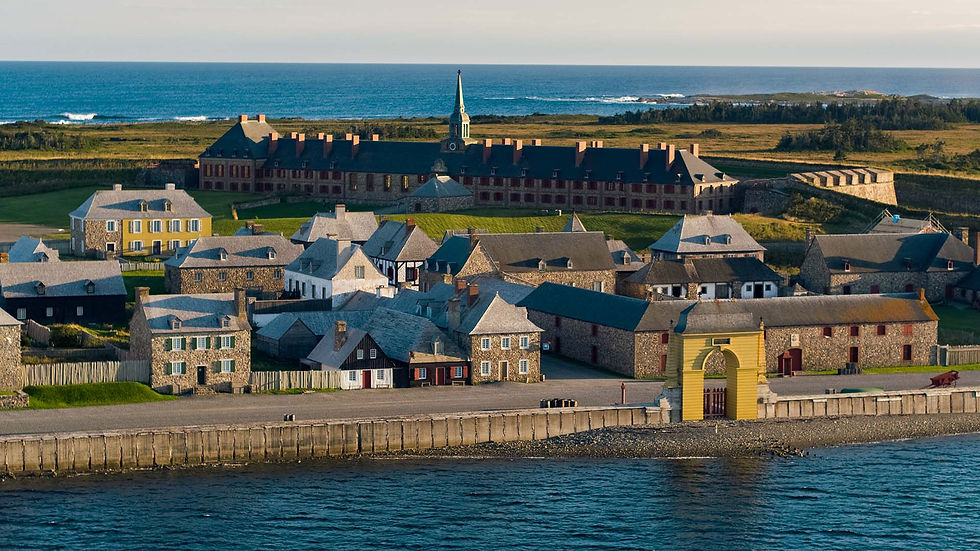
The Fortress of Louisbourg is a National Historic Site of Canada and is the largest historical reconstruction in North America.
Surrounded by Cape Breton’s rocky shoreline, the site brings you back to French colonial life between 1713 and 1758. Our visit provided us with the unique opportunity to experience life during the French occupation of Canada.
I was very excited about this excursion because it was like stepping back in time.
After a brief overview of the site, we toured the fort and mingled with period-costumed interpreters portraying historic characters. We saw the meticulously restored buildings, including the Chateau Saint Louis with its beautiful furniture, tapestries, and paintings. We strolled the streets and meandered through the gardens that mimic the gardens of Versailles in France. We caught a glimpse of ruins and a lighthouse as we explored one of the hiking trails. Re-enactments erupted at every turn as we walked around the property, and we truly felt that we were re-living the excitement of a day in the 1700s!
We also met “regular” costumed folks – those that performed the day-to-day tasks in 18th-century Nova Scotia, who gave us impromptu demonstrations on open hearth cooking, cloth-making, and French basket-weaving. At the bakery, we had a taste of “soldier’s bread,” the hearty and healthy bread that is baked fresh daily in traditional stone ovens, following an 18th-century recipe. At the forge and military barracks, we got to learn how to make a musket ball and how to take care of soldier equipment and weaponry. We even got the chance to fire a cannon!
The weather that day was cloudy and the sky had a foreboding of a storm coming. The atmosphere added to the air of mystery and it made our make-believe life in the 18th century seem realistic. We felt like we were in a movie set, shooting a period film, and Mother Nature cooperated by providing us with the perfect mood lighting. There were even sheep, chickens, goats, and geese that roam the grounds that made the place feel very much lived-in.
But apart from enjoying the 18th-century atmosphere, we also learned a lot about the fortress’ rich history. Two defining battles in Canada’s history took place at this fort in 1745 and 1758, involving the French, English, Acadian, Scottish, and Mi’kmaw. The fort was a critical French stronghold in Cape Breton and was, of course, a target for sieges. In 1745, New England colonists captured it in 46 days. It was returned to France in 1748, but was retaken by the British in 1758 after a seven-week battle, leading to its destruction.
Our guide joked that the French never learned their lesson. Their first defeat was due to lack of supplies and relentless bombardment. They got a second chance, but on the second siege, the British forces cut off the harbour (thus stopping the flow of supplies for the French) and once again bombarded the fortress for seven weeks straight. This time around, they had to surrender completely because the British also destroyed the last of their ships in the harbour.
The first battle demonstrated the military capability of the American colonial militia. The second one marked a turning point in North American history, ending French colonial dominance in Atlantic Canada and opening the path for the British capture of Quebec in 1759.
This was indeed a big blow to the French settlers, and until now, they have not forgotten.
But embarrassment, defeat, and bad memories aside, the Fortress of Louisbourg became the site of the first observatory in Canada. Three hundred years after its fall, someone realized that the dark skies over the fortress make it the perfect place to stargaze. One can go there and stay overnight as part of the site’s “18th-Century Overnight Experiences” program.
We ended the tour with a stop at the gift shop where my husband bought a commemorative plate for his parents. You see, the street where they live in Montreal is called Louisbourg. What a coincidence!
As we drove back to the ship, I told my husband that we should definitely go back to Cape Breton Island. There is still a lot to see and do around the island that we did not have the time for on this brief stop.
One day, I would like to hike along the scenic Cabot Trail or walk along the shores of the famous Bras d’Or Lakes. I would love to visit the 50-acre Nova Scotia Highland Village that provides a chronological journey of the island’s Scottish heritage through a tour of 180 years of Cape Breton’s Scottish architecture. It is hosted by staff trained in conversational Gaelic. How interesting! I would also love to visit Baddeck, where Alexander Graham Bell spent the last years of his life, and learn more about him at the Alexander Graham Bell Museum.
My husband, on the other hand, was keener on going back to do the Cape Breton Mine Experience at Black Gold Mines, where one can go to an actual underground coal mine located beneath the museum and see a demo of coal mining performed by retired coal miners.
Back at the port, we spent the rest of the afternoon and early evening strolling around the harbour. The cruise pavilion, which was right beside the giant fiddle, was turned into a marketplace with stalls showcasing local products and arts and crafts. And of course, our window-shopping spree was made festive by live fiddle music and sea chanteys. I felt like doing a stepdance, except that I had no idea how.


Comments