
Sarajevo, A Blend of East and West

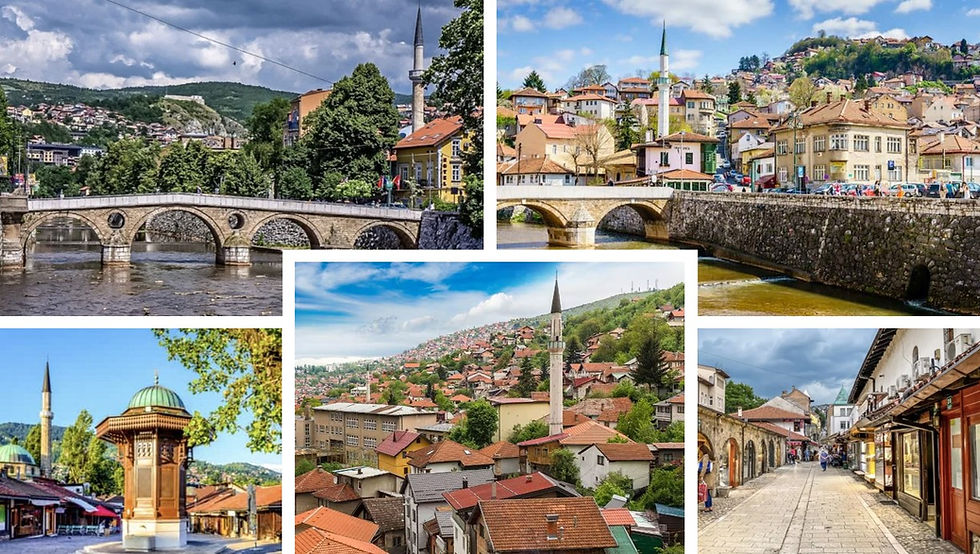
Sarajevo is the capital and largest city of Bosnia and Herzegovina. It is located in the greater Sarajevo Valley of Bosnia, surrounded by the Dinaric Mountains (which we just traversed) and situated along the Miljacka River.
The first thing we explored in Sarajevo was the Old Town. I couldn’t help but notice how starkly different it is from any European city I’ve been to. In fact, it felt like I was outside Europe, or maybe, its outskirts. The vibe was a blend of East and West. The skyline was decorated by a mix of Romanesque towers of Catholic churches, the onion-shaped domes of the Orthodox churches, and the spires of the mosques and minarets.
On one side of the main street was a line of buildings with Austro-Hungarian architecture and shops with Western or Cyrillic signs, while on the other stood a colourful bazaar that looked like it belongs to a Turkish city. I saw people in Western attire doing their business and shopping, but a good majority were also women in colourful abayas and hijabs or even black burqas, and men in tunics and loose trousers.
There were kafanas (coffee shops) offering traditional Bosnian strong coffee, hookah bars for those who’d like to smoke flavoured tobacco on the traditional pipe, and Western bars offering beer and wine.
We went to the Bascarcija, the historic market. During the Ottoman period, this was the main artery of the city, the main trading centre, and the main hub for social activities. Nowadays, it still has two covered bazaars, one on each side of the Gazi Hurev Bey’s Mosque and Islamic library. The market hosts an array of workshops of famous artisans and old-style inns converted from ancient caravanserais.
We conglomerated at Pigeon Square, in-between the two bazaars. It was obviously named after the flock of pigeons hanging around the area, waiting to be fed by the crowd. In the centre is an Ottoman-style wooden fountain called Sebijl built in 1753 and still functions today. This is the most popular meeting place in the market, and thus, our Tour Director announced that we had around two hours to have lunch on our own and maybe browse around the marketplace before we were supposed to come back for the walking tour arranged with a local guide.
I was excited to explore and see what the bazaar had to offer. All around were colourful goods waiting to be examined – carpets, copperware, lamps, robes, and souvenir items. And already, I could smell the aroma of roasting meats and exotic spices.
Our Tour Director told us that this marketplace is also the city’s centre of gastronomy. It is here where you could find the best cafés and restaurants in town. Then he announced that he was going have his own lunch at this steak place that has the widest selection of Bosnian food, mostly meat – “very good and very cheap meat.” Naturally, I followed him because I knew he was going to lead us to the best food and asked if it was alright to join him. The two American ladies, the Aussie guy, and three British ladies joined as well.
The place is called Bosanska Kuca, a small eatery not far from the bazaar entrance. The owner got us a nice, long table at the patio and presented the menu. I guess our Tour Director was not joking when he said this place has the widest selection of food. The menu was more than twenty pages with tantalizing pictures and descriptions of each dish. The prices were quoted both in euros and the local currency and judging from the size and quality of the food as shown on the picture-menu, they were indeed cheap.
I couldn’t help but take pictures of the menu pages. I was planning to show this to my husband who is a huge meat-eater. He would have his fill in this city if he visited, that’s for sure. They even had schnitzels on the menu. I was not sure if this was similar to the one you can find in Austria or Germany, but this is definitely a remnant of their Austro-Hungarian past.
I ordered the cevapi or cevapcici, grilled minced meat, served with somun, which is a type of grilled flat bread similar to pita. Although this dish is a Balkan staple, it is considered the national dish of Bosnia and Herzegovina, and the Bosniaks claim to have the best version. Luckily, this restaurant also serves alcohol (as some establishments don’t because they cater mostly to Muslim clientele), so we all ordered wine.
Our plates arrived huge as expected, so we took this opportunity to swap items so we could taste as many local specialties as we could. The older American lady ordered the Japrak Dolma, minced meat and spices wrapped in grape leaves, while the younger American lady had the Klepe Ravioli, Bosnian-style ravioli with minced beef and rice inside and topped with cream cheese. The Aussie guy opted for the Bosanski Sahan, which was a mixed appetizer plate of different dolmas – stuffed grape leaves, stuffed bell peppers, and stuffed tomatoes. The British girls ordered the same thing I got, and our guide had a humongous steak. We had a hearty meal and an interesting conversation on travel, learning new languages, and family life.
There was still some time to peruse the shops before our walking tour. Our Tour Director told us that if we were looking for unique souvenirs, Sarajevo offers very interesting ones. And interesting they were indeed!
There were handicrafts made from spent bullets such as keychains, pens, pins, and other trinkets that the locals collected from the war and repurposed (though it may not be a good idea to carry bullet souvenirs in your carry-on luggage). There were all sorts of war paraphernalia from the Yugoslavian wars ranging from badges to helmets to knives.
There were exquisite pieces of Ottoman-style copperware, handmade by the onsite artisans. I recalled his warning about stores selling cheap knockoffs, and his recommendation to get copper goods from Coppersmith Street, where they would be certified authentic, and where we could even see a demonstration of copper-making.
There were traditional carpets and handwoven rugs and the pointy slippers that Bosnians wear inside the house. There were bottles of good red and white local wine grown from grapes in the fertile Herzegovina region. I feasted my eyes on all of them, but I didn’t buy anything except for a magnet. What I found curious though were the Bosnian Pyramid souvenirs. Yes, pyramids in Bosnia! I had an interesting conversation with our guide about this later that evening at our hotel lobby.
We walked back to the Sebjil fountain shortly and our walking tour began. Our local tour guide gave us an overview of Bosnian history and then led us to the most iconic symbol of the city – the Vijecnica. It is currently the city hall, but this building has a lot to tell in terms of architecture and history, he said.
Built during the Austro-Hungarian period, it has a stylistic blend of historical eclecticism. Its Islamic-style arches and dark orange and yellow horizontal stripes make it a perfect combination of Oriental and Occidental elements. It was designed by an Austrian architect who got inspiration from the Mamluk architecture that flourished in Cairo between the 13th and 16th centuries, as well as from Moorish elements from Northern Spain.
The city authorities occupied it upon its completion in 1896, and in 1949, it was turned over to the National and University Library. It met its tragic fate in 1992 when in went up in flames during the Siege of Sarajevo. Not only was the building destroyed, but it lost almost two million books in the fire. Among those were 700 manuscripts, a unique collection of Bosnian serial publications including some from the 19th-century Bosnian cultural revival, and over 155,000 rare books. Our guide said that during the fire, some desperate librarians and citizens tried to save the books by putting themselves on the line when there were snipers all over the place. It was a big cultural loss!
After the war, the city worked on its restoration, and it was officially opened to the public in 2014. Now, the public can admire it’s beautifully restored interior, including a stained-glass ceiling, and can view the exhibitions about the war in its octagonal basement.
Our tour guide then led us through a stroll along the Miljacka River and showed us the several bridges that join the banks. Each bridge has its own unique and fascinating story about the bridge itself, the part of town that it is located in, and the people connected to it. He said that the river flows through the entire city and divides it into two halves – the southern and the northern side, or as the locals dub them – the Bistrik (mildew and damp), and the Vratnik (sunny) sides.
The Bistrik district dates back to the 15th century on the southern side of the river which starts at Latin Bridge (more on this later) and up the hill. On this side, one can find the bright, red-painted Church of St. Anthony de Padua, which served as the first cathedral of the Bishop of Bosnia, and its adjoining Franciscan monastery.
It also features the Sarajevo Brewery and Museum. This brewery is not only the birthplace of the Bosnian beer Sarajevsko Pivo but also played a crucial part during the siege by supplying water to the residents. Their underground natural springs were a lot safer than the open water fountains around the city. By doing this, they saved the lives of hundreds of people, especially children, who could have been easy targets for snipers.
This district is also home to the Bistrik Railway Station, where the Austrians built the first tram service in 1884 as a type of “practice” or “experiment” for the one that they were going to build in Vienna. At the time, trams were fairly new, and to avoid embarrassment from potential “errors” in their home country, the Austrians decided to test them first in Sarajevo.
This is also where the Jewish community settled. During the Austro-Hungarian rule, two Jewish communities thrived there – the Sephardic and the Ashkenazi Jews. The Asknazi community built a synagogue there in 1901 that remains active today. It is the first Jewish religious building that was built in the neo-Moorish Mudejar style.
On the other hand, the Vratnik is one of the oldest neighbourhoods in Sarajevo and it is where the ancient walled city, built in 1697 was situated. Today, all that remains of the old Vratnik are towers, ramparts, and gates that bear witness to times long gone.
Next, he took us to the “Sarajevo Meeting Point of Cultures” spot on Ferhadija Street. On this street, there is a marker on the ground where “East Meets West,” and where two different civilizations collide and connect.
It is a popular place for picture-taking because here, you get a “two-for-one” photo. If you face west, the background of your photograph will be “eastern,” with the mosque and Ottoman buildings behind you. If you turn 180 degrees, you will have a “western” background, with buildings in the Austro-Hungarian architecture instead. How cool is that? Several of our youngster travel mates stayed for a bit for their Instagram shots and video clips.
Our guide pointed out that Sarajevo earned the title, “The Jerusalem of Europe” because of its centuries-old multi-culturalism and the co-existence of Christians (both Catholics and Orthodox), Muslims, and Jews. He did not need to elaborate because we could see the proof everywhere.
As we walked around, he pointed at several buildings of either architectural or historical significance. But one will not fail to notice the scars of the war. No matter how beautiful the façades of some buildings are, especially those that have been transformed into shops and restaurants, the bullet holes from the war were still there, and it looked like they were left untouched on purpose. It seemed to me that the Bosnian people were still in the process of healing but are not quite ready to patch up the wounds of war yet.
As another example, our guide showed us one of the iconic “Roses of Sarajevo.” It is a type of memorial made from a concrete “scar” caused by a mortar shell’s explosion that was later filled with red resin. These mortar rounds that landed on the concrete streets during the Siege of Sarajevo created a unique fragmentation pattern that look almost like a floral arrangement, and with the red colour, reminds one of a rose. Pretty as they are, they are a painful reminder of the death and violence that occurred here. Around the city are approximately 200 “roses” that are marked on locations where at least three persons have been killed. If you do the math, you can just imagine the casualties of the war.
He then took us back to the bazaar where he introduced us to some local artisans in their workshops. Sarajevo artisans enjoy a tradition that is as old as Sarajevo itself, be it in copperware or carpet-weaving. On Coppersmith Street, we could hear the sounds of tiny hammers as coppersmiths meticulously pounded designs passed on from one generation to the next on their copperware – coffee sets and platters, pitchers and pots, lanterns and lamps, bracelets and jewelry boxes – each exquisitely etched using various techniques. He said that should we be interested in taking home some of these masterpieces, we should ensure that the shops we do business with display the “Sarajevo Original Quality Seal” as this is the best guarantee of the authenticity and quality of the both the artisan and the product.
He also took us to the sections that specialize in handmade carpets and leather goods before we went to an old caravanserai (roadside inn where caravan travelers could rest and recover from the day’s journey, sort of like an ancient hostel for men and horses) located in a covered section of the marketplace.
The Morica Han was originally built in 1551 to accommodate 300 passengers and 70 horses and has survived several fires throughout the centuries. It was reconstructed from 1971 to 1974 and decorated with Persian calligraphy. At present, it houses a restaurant, a Persian carpet shop, and an inn for a religious society. Its courtyard, dotted with round tables and comfortable chairs looked so inviting. Partially shaded by trees, it was a perfect place to sit down and enjoy a traditional Bosnian coffee service with a small plate of Turkish Delights. I was standing next to the American flight attendant and we both had the same idea. However, our walking tour was still ongoing, so we said maybe we could go back there later to chill.
As our local guide was presenting, we heard thunder and soon, we noticed the dark clouds and saw intermittent lightning in the sky. It was evident that some kind of flash storm was brewing. I told my American tour mate that this would be a good place to pass the storm because we were in a covered building, and she added that we could pass the time sipping our Bosnian coffee and eating our Turkish Delights.
But alas, our local guide elected to move on. He took us to the Havadza Durac Mosque, also known as the Bascarsija Mosque, which is located on the main square of the market. The medium-sized mosque has a single dome and an open portico covered by smaller cupolas. It has an adjacent minaret and in the centre of its courtyard is a fountain surrounded by rose bushes and two poplar trees.
It was there when the storm caught us without warning. After a loud thunderclap and a couple of lightnings, the downpour began and intensified within a few seconds. We all rushed to the fountain, which was thankfully covered, but not enough to shelter all 40 of us plus our tour guide. Some of my tour mates had raincoats and umbrellas in their backpacks, but they were as easily soaked as the rest of us who had no rain gear. My American pal said, “See, we should have stayed at the caravanserai restaurant,” and I nodded in agreement.
After a few minutes of enduring the onslaught from the sky, it was evident that it was not going to stop anytime soon, judging from the still-dark clouds and the howling wind. Our local guide made the executive decision to continue when the raindrops abated a little bit. I guess we had no choice because he had another tour after ours and our group was also on tight schedule.
We followed him as he showed us a typical mahala, a residential street. According to him, since the main marketplace was built in a valley and became the centre of trade, the residential streets were built on the slopes on the surrounding hills. A mahala usually had a mosque in the center (such as the one we just saw), along with its mekteb (religious school for youngsters) and a harem (a courtyard with a cemetery). The mahala would also have a public fountain (such as the one under which we sought shelter), a bakery, and a shop. The basic rule that was followed when building a house in the mahala was to give one's neighbor “the right to a view”, so the houses were built on slight inclines.
It was still raining and the water was ice-cold, so we again sought shelter under one of the covered sections of the bazaar. We spent a few minutes looking at souvenirs, waiting for rain to stop, but it still didn’t. Our guide then announced that we had the last two steps left for the tour, but they involved a bit of a walk outside. We were given some options. He said he could take those who were willing to go under this torrential rain and the rest could stay somewhere warm and dry and he’d come back for the second batch, that is, if the weather would get better.
I was torn between not missing the most important part of this tour and not getting sick. But our local guide was too fast. Before I could make up my mind, he rushed outside and a herd of around fifteen followed suit. They ran so fast that I didn’t have time to keep up. So, I guess, Mother Nature made the decision for me.
Our Tour Director, who stayed with the rest of the group, said he’d take us to a nearby pub which was just a block away. There, we could sit and warm up with some strong Bosnian cocktails. I guess that was a good option, given the inclement weather.


Comments