
Historic (and Haunted) Halifax

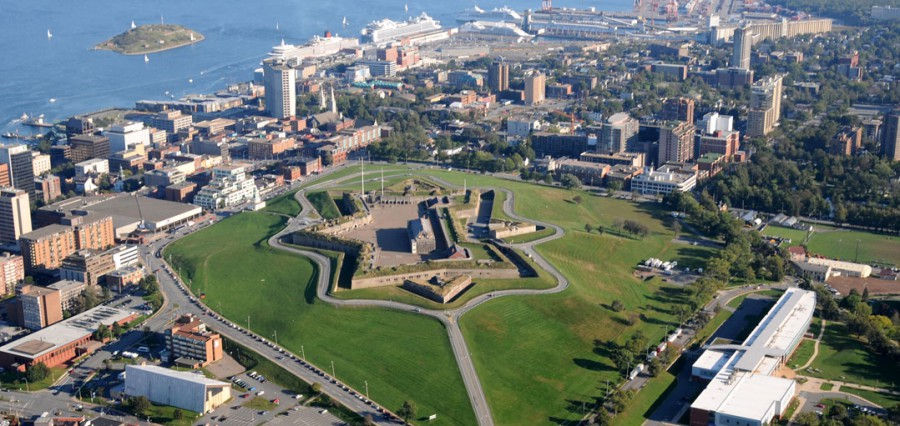
Located on a rocky inlet on the Atlantic Ocean, Halifax, Nova Scotia’s provincial capital, is defined by its maritime geography.
We were welcomed by a bustling waterfront as we arrived. We were made aware of the fact that this is the same waterfront where steamships once anchored to drop off arriving immigrants from the Old World, many, many years ago.
In modern times, it has become a central hub for locals and visitors, always buzzing with energy that is fed by a working port, casual joints, street vendors, local artisan shops, and year-round businesses surrounded by the sparkling ocean.
Naturally, the first order of the day was to stroll along the four-kilometer Harbourwalk, which winds along the colourful wharf.
We started our walk from the “historic properties,” where three blocks-worth of warehouses and Victorian houses dating back to the 1700s have been restored and given a new life as modern-day bars and restaurants, upscale shops, and charming boutiques. We passed by the Maritime Museum of the Atlantic, but did not have the time to go inside. This museum houses many nautical and naval artifacts, including permanent exhibitions on the Titanic and the Halifax Explosion.
We also saw booths where one can book boat tours and whale-watching excursions. The boardwalk ends at the Farmers’ Market and the Canadian Museum of Immigration at Pier 1, then it was time for us to go back, for we booked an excursion for the afternoon.
We signed up for the historic city tour, which took us on a drive around the vibrant capital city, winding through the streets of the Halifax peninsula. Stunning 18th- and 19th-century buildings were interspersed with ultra-modern glass towers. In downtown Halifax, we saw the Province House, referred to as “a gem of Georgian architecture” by Charles Dickens himself, who passed through here in the 1840s. We drove past the 215-year-old Town Clock and City Hall, and the Grand Parade. This old military parade square is home to Halifax's oldest building – St. Paul's Anglican Church. During our entire drive, I was smitten by the tree-fringed streets lined with elegant Victorian buildings.
We stopped at the Halifax Public Garden where we took pictures by a pergola and fed the swans and Canada geese swimming in the pond dotted by fountains and small bridgeways. This beautiful green space right in the centre of the city is one of the finest surviving examples of a Victorian garden in North America.
The excursion also included a drive up to the Halifax Citadel National Historic Site, which is a majestic, star-shaped, hilltop fortress built in 1828 overlooking the harbour below, and was considered the crown jewel among the most advanced British military fortifications of its day.
They say that the city of Halifax owes its existence to The Citadel. From a wooden guardhouse on top of what would eventually be called Citadel Hill, it grew into a small town when the first settlers started building their homes at the base of the hill, closer to the water.
Over the years, as the fort grew, so too did the town, with much of Halifax dedicated to supplying the soldiers with both essential supplies and off-duty entertainment.
Today, it continues to watch over the downtown core, but is no longer used as a military fortification. It is now a reminder of Halifax’s rich history and what better way to do this than to turn this landmark into a living history museum.
Inside, we interacted with military interpreters, who were actually members of the 78th Highlanders and the Royal Artillery. Dressed in the same uniforms that their respective regiments wore in the mid1800s, they guard the Citadel’s entrance and conduct marching and band drills on the parade grounds.
The Citadel was so alive with the sounds and colours of military life, and we became active participants. We posed for photos with the costumed military guards, listened to live bagpipe music, watched the changing of the sentry guard’s ceremony, and gathered with the rest of the crowd at noon for the “Noon Gun,” a local tradition that has been followed since 1857 and is considered the oldest in the world. The gun is fired daily by the 3rd Brigade Royal Artillery to announce the noon hour. We were told this can be heard across the city.
We spent the rest of our time walking around, climbing lookouts and towers, and examining cannons up close.
We discovered that there were special tours conducted inside the fort. One was the “Raise Your Spirits” tour, in which a kilted 78th Highlander will share the history of alcohol use in the British Military and lead the tasting of three citadel-aged spirits, paired with a variety of artisanal cheeses. Tempting, but no, thanks! Too early in the day, hahaha!
The other one was the “Citadel Ghost Tour,” which I would have considered doing, but it’s only conducted at nighttime in candlelight! Apparently, this place is rife with ghostly apparitions and strange sounds, especially along the ramparts, dungeons, and dim passageways. Sounds spooky!
It was a particularly hot and humid day, so my husband and I unconsciously stayed in the air-conditioned gift shop longer than we were supposed to. By this, I mean that we totally lost track of time and forgot that we were supposed to go back to our bus at a certain time.
As we were paying for our souvenir items, we heard some loud drumming, a musket shot, and a public announcement through a megaphone. Thinking that another military demo was about to start, we quickly ran outside to see what the commotion was about.
The 18th-century soldier stood straight and rolled down a piece of parchment paper to make a proclamation.
He announced rather dramatically, “Bus # so and so is leaving in five minutes and the driver is waiting for missing passengers X and Y. Passengers X and Y, if you can hear this, please make your way to your bus immediately.”
It took us two seconds to realize that it was our bus number being called out and that “missing passengers X and Y” were us. Oh my! That’s when we realized we were late. Where had time gone? We shouted a grateful “thank you” to the soldier and made ourselves disappear in the crowd. How embarrassing!
So off we ran to the parking lot as fast as we could, found our bus, and with heads down like puppies guilty of a naughty deed, we boarded the bus and apologized profusely to the driver and our fellow passengers as we did the “walk of shame.”
Most of the grandmas and grandpas were just laughing. One of them asked us how we liked the “special announcement,” to which we replied, “Loved it! It certainly got our attention and embarrassed us to pieces!”
But there were a handful of them who were also shaking their heads, rolling their eyes, clucking like mother hens, and muttering, “These young people!” Oh well!
The rest of the tour went without further delay this time, and we even got a bonus. Our bus driver stopped in front of the Fairview Lawn Cemetery, where several victims of the Titanic sinking are buried. According to him, 121 victims are interred there, more than any other cemetery in the world, since Halifax was the closest harbour to the site of the wreckage and a lot of bodies turned up on its shores.
The driver mentioned that one of the graves there is marked “J. Dawson” and following the release of the 1997 film which starred Leonardo di Caprio in the role of Jack Dawson, the grave gained fame and many film fans trooped there to leave flowers and ticket stubs.
To this day, there is still a stream of flowers being left by fans who were obviously moved by the Titanic love story. However, according to filmmaker James Cameron, the character in his movie is fictional and not at all inspired by this grave. In fact, research has revealed that the grave belongs to Joseph Dawson, an Irishman who worked in the Titanic’s boiler room as a coal trimmer. There was no Jack Dawson in real life, so I apologize for bursting your romantic bubbles.
Our bus driver just thought he would let us know, even though this was not part of our tour. He added that if we really wanted to go inside the cemetery and see this grave, we should register for the “Titanic Tour” which would also take us to the Titanic exhibit at the Maritime Museum of the Atlantic. Perhaps, he is a huge fan of the movie, that’s why he felt compelled to take us there.
I would have loved to see the Titanic exhibit (although a few months later, we went to see the one in Victoria, British Columbia). For some reason, the poignant story resonates with me, and looking at mementos from the ship brings me some comfort.
My husband pointed out that it is probably not a good idea to see an exhibit about a sunken ship while we were on a cruise that would take us sailing in the Atlantic Ocean. Good point!
However, I told him that I’d still love return to Halifax for this, as well as for the “Haunted Halifax” tour. Being a harbour city, Halifax certainly has a fascinating history of shipwrecks, ghost stories about hanged pirates and merchant seamen lost on the high seas, blood-thirsty privateers, and heroic sea adventures bedecked with tales of spurned lovers, ill-fated captains, and other maritime controversies. I would also love to go back for a trip to Peggy’s Cove, which we did not get to visit on this cruise.


Comments